
Mastering Posture: Overcoming the C-Posture in Golf for a Better Swing
- Christian Engström
- 1 nov. 2024
- 5 min läsning

Uppdaterat: 2 nov. 2024
For average golfers at all levels, one of the most common yet limiting postures is the “C-Posture.” This occurs when the shoulders slump forward at address, creating a rounded back that extends from the tailbone to the neck. While it may seem like a simple setup mistake, C-Posture can drastically limit your ability to rotate in the backswing and maintain consistent posture throughout your swing.
C-Posture

Understanding C-Posture and Its Impact on Your Swing
When a golfer adopts a C-Posture, they effectively reduce the mobility in their thoracic spine (upper back), which is essential for a full, powerful backswing. Excessive rounding of the upper back restricts rotation, making it tough to maintain balance and stability as you swing the club. Often, golfers with C-Posture struggle to keep the backswing short and wide—a crucial element for staying in control of the club.
Physical Causes of C-Posture
While some players may fall into C-Posture simply due to poor setup habits, the majority of cases are rooted in physical limitations and muscle imbalances that develop over years. Key contributors include:
Chest and Upper Back Muscle Tightness: Tight chest muscles and latissimus dorsi, as well as restricted muscles in the upper thoracic spine, can pull the shoulders forward and limit your range of motion.
Limited Thoracic Spine Extension: The ability to extend or “puff out” the chest is essential to achieve a neutral spine. Without it, golfers often find it nearly impossible to correct C-Posture on their own.
Weakness in Stabilizing Muscles: Muscles between the shoulder blades, front neck muscles, and those surrounding the shoulder blades play a big role in maintaining upright posture. Weakness in these areas can lead to instability, making it challenging to hold proper form.
Pelvic Mobility and Core Strength: Lower back stability, coupled with core strength, allows golfers to perform proper pelvic tilting (arching and rounding the lower back), which is fundamental for a strong posture.
Why Adjusting Posture Isn’t Always Enough
While adjusting the posture at setup may help some golfers, those with muscle imbalances and joint restrictions will often find that simply “trying to stand up straighter” does little to improve their swing. This can even harm the swing by forcing unnatural movements that lead to further imbalance. Instead, the most effective way to address C-Posture for good is by strengthening and lengthening specific muscles in the gym or working with a physical therapist.
Exercises and stretches for improving C-Posture
Drills position / posture
W-Turns

If you get very rounded shoulders you will need to pull your shoulders back.
To do that you can grab a club and pull it over your shoulders and create a W position (see picture to the right). Get into your set up position by hinging from the hip and try to feel how your shoulders stay back.
Then drop the club down but feel how you keep your shoulders back.
Hip bar hinges

Take a club and put it over your hips. Push your hips back and bend forward, and bend the knees. Then drop the club to get in a good posture.
Pull shoulders back drill
A great drill to get after the roundness of the upper back. Pull your shoulder blades back and try to feel like you pinching something between your shoulders.
Exercises for mobility and stability
Cat / Cow
1. Start on your hands and knees in a table position, keeping your spine neutral. Inhale as you move into cow pose by lifting your sit bones upward, pressing your chest forward, and letting your belly soften.


2. Lift your head, ease your shoulders down away from your ears, and look straight ahead.
3. On your exhale, transition into cat pose by rounding your spine outward, tucking your tailbone, and gently pulling your pubic bone forward.
4. Lower your head toward the floor, but don’t force your chin to your chest. Most importantly, stay relaxed.
Wall rotations
Begin in a half kneeling position. Both hands pointing in front of you, rotate the outer arm open as attempting to reach the wall behind you. Exhale as you rotate, inhale as you revert back to neutral and repeat. Do 3 sets with 8-10 reps on each side


Reach backs
Start by getting down on your hands and knees. Keep your back straight and bend one elbow and place your hand on the back of your head.
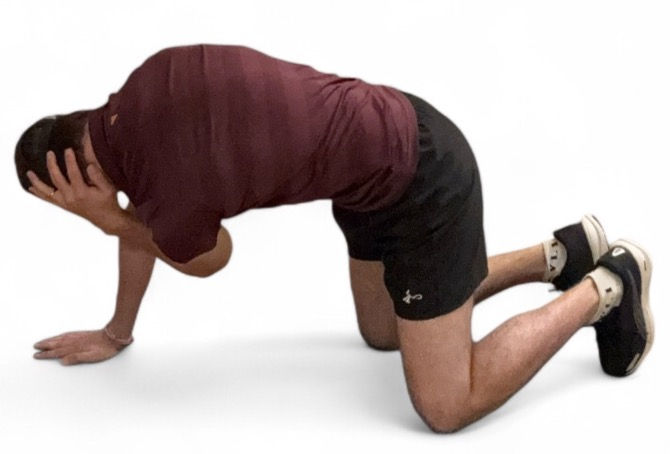
Start by trying to touch your elbow to the opposite knee. After you go down as far as you can then rotate up so that your elbow points to the ceiling.

Do 3 sets with 8-10 reps on each side
Chest opener
Stand with your feet about hip-width apart.
Pull your arms back, interlace your fingers, and press your palms together. Place a towel in between if your hands cannot reach each other.
Keep your head, neck, and spine aligned in a straight line while looking straight ahead.
Inhale as you lift your chest toward the ceiling and stretch your hands toward the ground.


Thoracic spine rotation
Lie on your side with your arms extended in front of you. Bend your knees at a 90-degree angle and keep your feet together on the ground. Slowly rotate your top arm towards the ceiling and continue to the other side of your body, all while keeping your eyes on your hand. Hold the stretch for a few seconds, then slowly lower your arm to the starting position. Repeat the exercise on the other side. Do 3 sets of 8-10 reps


Exercises for strength
Plank
Begin in the plank position, face down with your forearms and toes on the floor. Your arms are directly under your shoulders and your forearms are facing forward.
Engage your abdominal muscles, drawing your navel toward your spine. Keep your torso straight and rigid and your body in a straight line from your ears to your toes with no sagging or bending. Ensure your shoulders are down, not creeping up toward your ears.
Hold this position for 60 seconds.

Side plank
Lie on your right side, legs extended and stacked from hip to feet. The elbow of your right arm is directly under your shoulder. Ensure your head is directly in line with your spine. Your left arm can be aligned along the left side of your body.
Engage your abdominal muscles, drawing your navel toward your spine.

Lift your hips and knees from the mat while exhaling. Your torso is straight in line with no sagging or bending. Hold the position.
The goal should be to hold for 60 seconds then return to the starting position. Change sides and repeat.
Standing rotation with rubber band


Use a cable or stand on a resistance band with one foot. Stand with your side facing the wall and hold the band with both hands. Pull your arms forward and upward in a circular motion to the opposite side. Return slowly and repeat.
Do 2 sets of 8-10 reps, then switch sides.
The Path to Better Posture and Performance
Correcting C-Posture is more than just improving your stance—it’s about building a foundation that supports a more fluid, powerful swing. By addressing any muscle imbalances and increasing mobility in your upper back, you’ll unlock your full range of motion, allowing for a stronger rotation and better control of the club. With a more neutral spine and balanced body, you’re set up to hit straighter shots with more consistency.
Whether you’re just starting out or have been playing for years, taking time to understand and correct C-Posture can make a big difference. Every golfer’s path is unique, but with some effort, you can achieve a posture that not only looks good but also enhances your performance on the course.

Kommentarer